Some people chase disruption. I chase structure.
While others promise transformation through chaos, I deliver clarity through discipline. This isn’t just philosophy. It’s methodology born from real experience leading complex systems where failure isn’t an option.
Innovation isn’t just about bold ideas. It’s about knowing where to begin. I believe in thinking big but starting small. That means breaking down complexity, identifying leverage points, and making consistent moves that build over time.
I learned systems thinking long before I knew what to call it. Whether analyzing user behavior, measuring the impact of technology adoption, or mapping workforce dynamics, I’ve always seen complex challenges as equations waiting to be solved, one variable at a time. I’ve applied that mindset across credentialing workflows, national technology strategy, and community-building through Association Latinos. The tools may change, but the focus stays the same: clarity, structure, and real-world value.
This approach is what I call Innovation by Parts™.
Why “by Parts”?
In calculus, integration by parts helps solve complex problems by separating them into more manageable components. The formula is simple: ∫u dv = uv – ∫v du
You isolate the tough parts, apply structure, and work through the challenge piece by piece.
That’s how I approach innovation. Especially in complex environments like associations and nonprofits, where big changes without structure often create more confusion than progress. Where digital transformation budgets don’t exist and stakeholder patience runs thin, structured innovation isn’t just preferred. It’s survival.
Innovation by Parts is about seeing the full picture, then moving with clarity, purpose, and discipline.
Part 1: Engineering Innovation Into the System
At NBCRNA, we didn’t wait for a massive rebuild. We created solutions within the systems we had. We built internal APIs, validation scripts, and a Single Source of Truth to make our credentialing workflows more reliable and scalable.
When we launched Longitudinal Assessment, we developed a data model that supported continuous insight over time. This allowed us to monitor user behavior, surface trends, and inform decisions across departments. We weren’t aiming for a flashy rollout. We were focused on building something that worked and could evolve.
These were deliberate moves. Measured steps with long-term value. Integration by parts in practice.
Part 2: Whiteboards as Mental Scaffolding
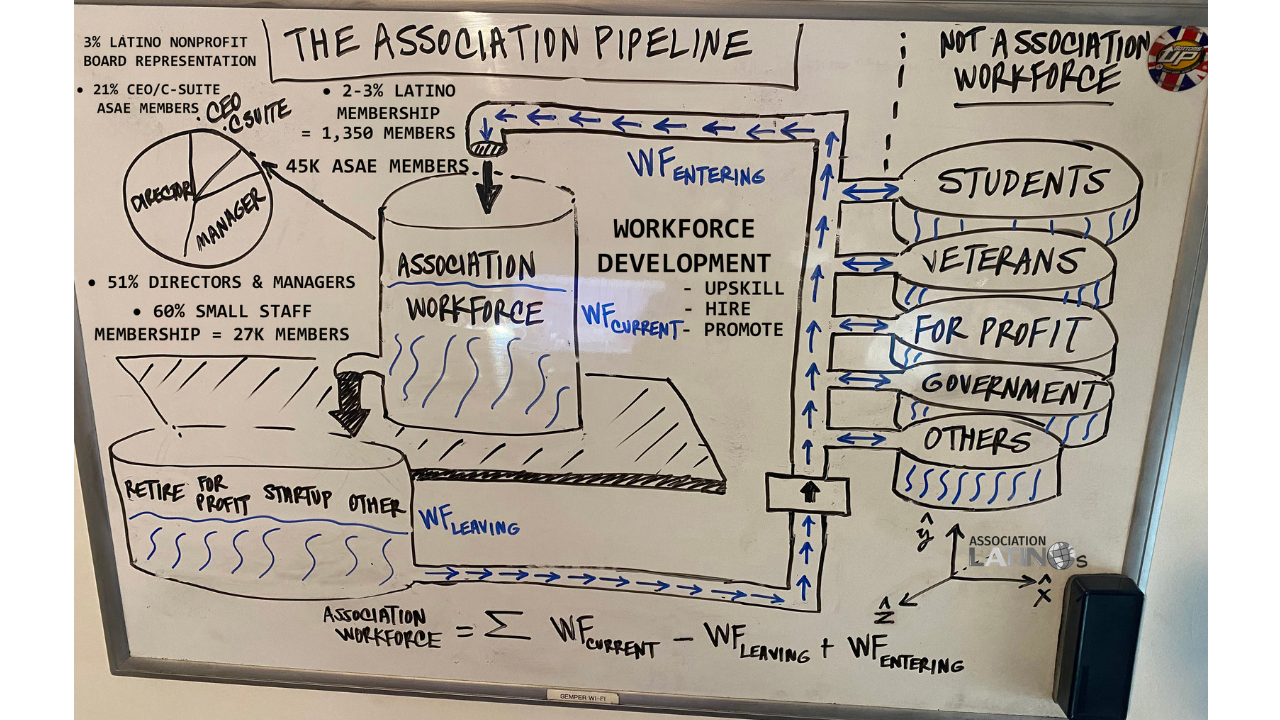
My work almost always starts with a whiteboard. Not because I’m old school, but because complexity becomes manageable when you’re forced to visualize the connections. The whiteboard becomes mental scaffolding, supporting the construction of understanding piece by piece until the full structure emerges.
It’s how I mapped The Association Pipeline framework, breaking down workforce dynamics into measurable components: Association Workforce = Σ (WFcurrent) – (WFleaving + WFentering). What started as a conversation about workforce challenges became a mathematical framework that transformed abstract concerns into actionable strategy.
It’s how I visualized Pelé’s impact on global football through mathematical modeling, treating fan growth as a function of time with discrete inflection points. It’s how I structured the layers of Tech Council work from strategic objectives down to collaborative outputs.
Each diagram starts with a question that seems overwhelming: How do we measure workforce sustainability? What’s the real impact of innovation? How do we organize complex strategic work? The whiteboard forces you to externalize the complexity, to see the relationships, to identify where the system can be influenced.
I took the same approach as Chair of ASAE’s Technology Professionals Advisory Council. We moved beyond meetings and created action. We launched a podcast, revived our LinkedIn presence, and started conversations on RAG AI, data strategy, leadership, and legal-tech intersections. None of that came from a top-down mandate. It came from showing up, asking the right questions, and making room to build.
The scaffolding metaphor isn’t just about visualization. It’s about creating temporary structures that support permanent understanding. Just as construction scaffolding provides support during building and is then removed, the whiteboard provides cognitive support during problem-solving. Once the understanding is built, the diagram has served its purpose. What remains is clarity, structure, and a path forward.
Part 3: Experimentation Is Structure
Thinking big means staying curious. Starting small means staying grounded.
Lately I’ve been working with open source LLMs like Ollama. I’m not trying to automate everything or chase hype. I’m learning how these models behave and figuring out where they can actually make a difference. From improving data access and workflows, I’m interested in what’s useful, not just what’s new.
This mirrors my early AI article in 2023, when I focused on algorithmic optimization, enhanced personal assistant capabilities, and creative enhancement rather than wholesale replacement of human judgment. The key was treating AI as a complementary tool for existing processes, not a revolution that demanded rebuilding everything.
Experimentation doesn’t have to be chaotic. When it’s part of a larger system, it becomes strategy. When it’s guided by clear frameworks, it becomes sustainable innovation.
Innovation by Parts Is a Mindset
You don’t need a blank slate to innovate. You need clarity. You need structure. You need to move with intent, even when no one’s watching.
I learned early in my career that the best plans survive contact with reality. That’s why I don’t start with roadmaps. I start with understanding what’s actually broken and why. I start with the whiteboard, where you can’t hide behind buzzwords when you’re holding a marker.
Innovation by Parts isn’t just about breaking things down. It’s about building them back up, systematically, until you’ve created something that works and lasts. It’s about seeing projects through to completion, even when the path takes unexpected turns.
This is how I lead. This is how I build. This is how I serve.
The next time someone pitches you a complete system overhaul, ask them to explain it on a whiteboard first. If they can’t draw it simply, they don’t understand it clearly. And if they don’t understand it clearly, neither will your team.
Think big. Start small. Build with purpose.
This is Innovation by Parts™. This is how you lead when it matters.
More to come.
Semper Fidelis