When I walk to a whiteboard, I usually have a complex problem that I’m trying to unpack in my mind. The whiteboard is my canvas for unpacking the complexity in thoughts, tasks, projects, and everything in between. It helps me simplify the complex.
When I struggle with complex problems, I grab a marker and make them visible. Not because I’m old school, but because it works when everything else fails to bring clarity to systems that seem impossibly tangled.
Complex problems live in our heads as abstract concepts that feel manageable until you try to explain them to someone else. That’s when the gaps show up, the assumptions surface, and the hand-waving starts. The whiteboard eliminates all of that by forcing you to be specific about what you actually mean and how the pieces connect.
You can’t draw “synergy” or “alignment.” When you’re holding a marker, corporate buzzwords become problems that need solving.
The whiteboard becomes mental scaffolding – temporary structure that supports your thinking while you build understanding.
Mental Scaffolding for Complex Systems
Take The Association Pipeline framework. For years, I’ve heard conversation circles discuss workforce challenges in associations using vague terms like “retention issues” and “pipeline problems.” Everyone was solving different problems with the same words.
So I grabbed a marker and drew it out: Association Workforce = Σ (WF_current) – (WF_leaving + WF_entering)
Suddenly, we weren’t dealing with abstract workforce concerns. We were looking at a dynamic system with measurable inputs and outputs, where every change in one variable affected the whole. The visual made the relationships impossible to ignore and gave us a framework for measuring what had previously been unmeasurable.
That’s what whiteboards do. They take invisible complexity and make it visible, manageable, and actionable. They become mental scaffolding – temporary structures that support your thinking while you build understanding, then get removed once the framework can stand on its own. Just like construction scaffolding supports a building during construction but isn’t part of the final structure, the whiteboard supports your cognitive work while you construct lasting insights.
When Behavior Becomes Mathematics
During my time on ASAE Tech Council, we tackled the member behavior decoding project – an attempt to understand membership retention and renewal as behavioral patterns rather than administrative outcomes. Traditional metrics like renewal rates and satisfaction surveys missed the deeper signals that tell you why members stay, leave, or disengage.
The challenge seemed overwhelming: how do you predict human behavior around membership value? How do you separate meaningful patterns from random noise? How do you turn engagement data into actionable insights?
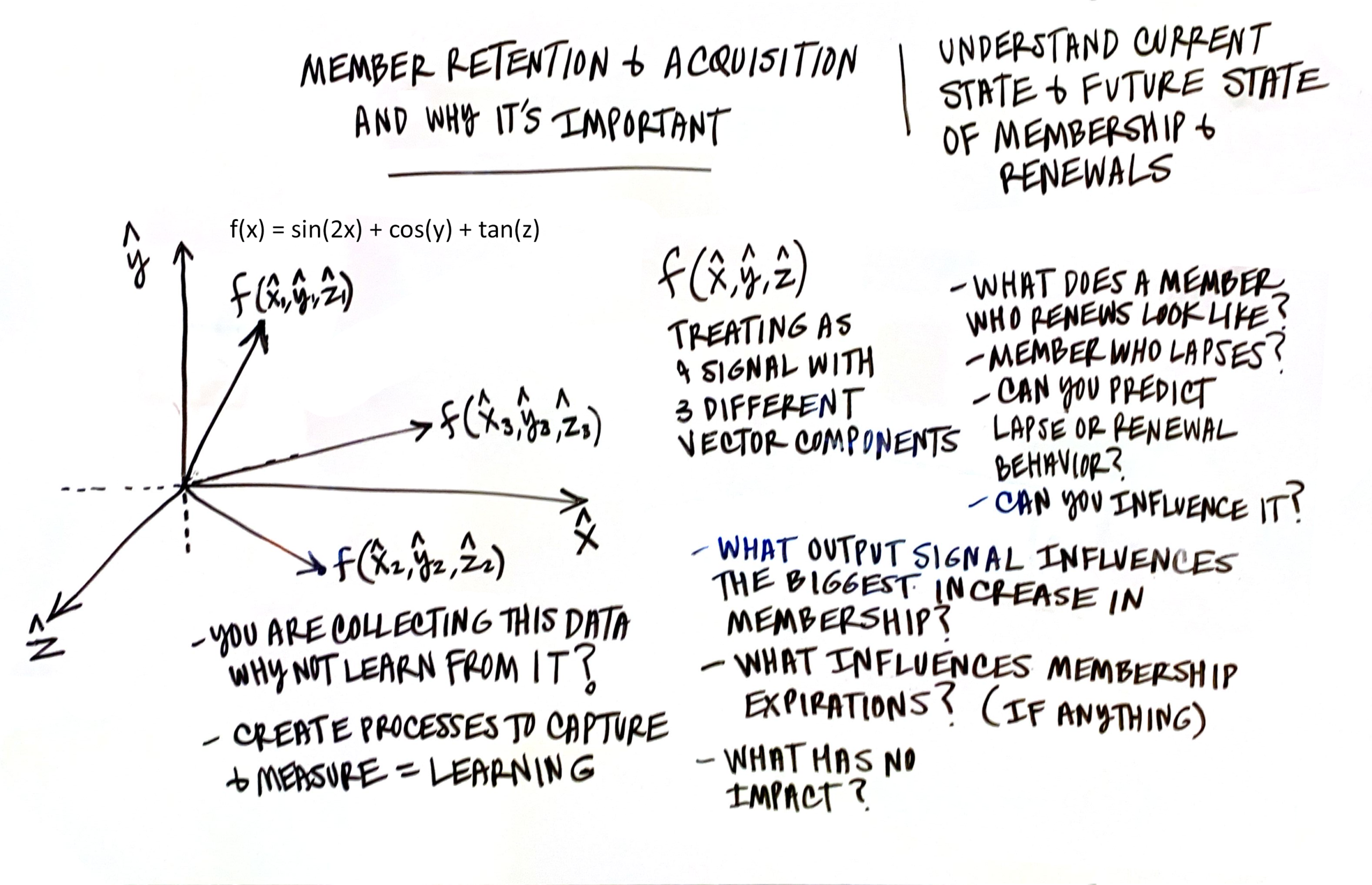
So I walked to the whiteboard and started thinking about member behavior as a mathematical function, and came up with a representative signal: f(x,y,z) = sin(2x) + cos(y) + tan(z). This wasn’t the actual equation we used – it was a representation of how we could think about membership activity as a time-based signal with three different vector components. The diagram helped us conceptualize engagement patterns, value perception, and social influence as measurable variables that could be analyzed independently while understanding how they affected the whole system.
Drawing this equation forced us to ask the right questions: What does a member who renews look like versus one who lapses? Can you predict lapse or renewal behavior? What influences membership expirations? What has no impact at all? The whiteboard served as mental scaffolding, supporting our thinking while we constructed a framework for understanding member behavior. Once we had the conceptual model, the diagram had served its purpose – the real value was the structured thinking it enabled.
Systems Thinking Made Concrete
The member behavior project (Podcast Series) exemplified how whiteboarding transforms abstract challenges into engineered solutions. Instead of endless meetings about “member engagement,” we diagrammed the relationships: input signals from logins, event attendance, email interactions, and committee participation flowing through validation and analysis to create predictive insights.
Drawing this system revealed something critical that conversation couldn’t achieve. We weren’t dealing with separate retention and recruitment problems. We were looking at a behavioral economics system where members respond to perceived value, loss aversion, and social proof. The visual representation served as mental scaffolding, allowing us to hold multiple complex relationships in view simultaneously while we built understanding of how to filter noise from meaningful patterns and identify leading indicators before members actually lapsed.
So, we created a Podcast Series with representation from membership, marketing, data science, executive leadership, and technologists! This is signal processing applied to membership data – treating human behavior like any other system that can be measured, modeled, and optimized.
Three Powers of Physical Thinking
First, whiteboards force precision. You can’t draw corporate buzzwords or hide behind vague language. If you can’t diagram it simply, you don’t understand it clearly enough to move forward. This constraint becomes a feature, not a limitation.
The member behavior equation emerged because we had to get specific about what actually influenced retention. “Member engagement” became measurable variables. “Satisfaction” became quantifiable signals. The marker demanded mathematical clarity where conversation allowed abstract discussion. The scaffolding forced precision.
Second, they create shared mental models. The most valuable moment in any whiteboard session happens when someone else grabs the marker and adds what I missed, corrects what I got wrong, or builds on what I started. That’s when individual confusion transforms into collective understanding.
The Tech Council team could see where their expertise fit into the behavioral model. Data specialists understood the signal processing components. Membership professionals recognized the behavioral economics patterns. Communications experts saw how messaging could influence the variables. The diagram created shared mental scaffolding that supported collective understanding across different specializations.
Third, they expose hidden assumptions. Complex problems contain invisible assumptions about how systems work, what drives behavior, and what can be measured. The whiteboard makes these assumptions visible by forcing you to draw the connections explicitly.
The member behavior diagram revealed assumptions we didn’t know we were making about what drives retention, how member value is perceived, and what interventions actually work versus what we hoped would work.
Why Physical Beats Digital
Digital whiteboarding tools exist. Remote work requires virtual collaboration. But when you need breakthrough thinking on genuinely hard problems, nothing beats a real board and a real marker.
Your brain remembers location better than sequence. When you place an idea in a specific spot on a physical board, you remember both the concept and its spatial relationship to everything else. There’s no interface friction – no menus to navigate, no tools to select, no lag between thought and mark. Physical boards create better mental scaffolding because they engage spatial memory and kinesthetic learning simultaneously.
Most importantly, when people gather around a physical board, they engage differently than they do on video calls. Shared focus and spatial presence create conditions for collective insight that virtual tools struggle to replicate.
Mathematical Precision in Practice
My whiteboarding process follows deliberate structure. Start with the core question written at the top. Map what you know – components, relationships, constraints. Identify gaps where understanding breaks down. Test scenarios using the visual model. Capture insights that emerge beyond what gets drawn.
When we were solving the “flatten the curve” problem for certification processing, I didn’t start with solutions. I started by mapping the historical pattern – 4.4K applications creating massive spikes that overwhelmed our systems. The diagram revealed the mathematical reality: divide 4,400 applications by 4 weeks, implement A/B/C/D testing for communication strategies, reduce system load while improving user experience.
The whiteboard forced us to see this as an optimization problem with quantifiable variables rather than an abstract “capacity issue.” The scaffolding supported our thinking until the mathematical solution became obvious and actionable.
Innovation by Parts™ in Action
This is Integration by Parts applied to problem-solving. You start with overwhelming complexity that seems impossible to tackle. You break it into components that can be visualized. You explore relationships systematically. You build understanding incrementally.
Each mark on the board represents a small step toward clarity. Each diagram becomes temporary scaffolding for larger understanding. Innovation happens through disciplined accumulation of insights made visible, not sudden breakthrough moments. The scaffolding gets removed, but the understanding remains.
The member behavior project exemplifies this approach. We took an abstract challenge (predicting human behavior) and broke it into concrete components that could be measured and optimized systematically. Think big (behavioral economics applied to membership), start small (specific engagement signals), build incrementally (predictive models that enable proactive intervention).
When Talk Fails, Draw
When your team talks in circles about complex problems, grab a marker and ask: “Can we draw this?” When stakeholders can’t align on priorities, map their perspectives visually and look for common ground. When you’re planning something ambitious but don’t know where to start, diagram the components until a path emerges.
The whiteboard won’t solve your problems for you. But it will provide the mental scaffolding to make them visible, manageable, and actionable in ways that conversation alone cannot achieve. It will force precision where there was vagueness, reveal connections where there was confusion, and create shared understanding where there was individual assumption.
I’ve used this scaffolding approach to map everything from association workforce dynamics to member behavioral patterns to operational optimization challenges. The methodology remains consistent: externalize the complexity, explore the relationships, build understanding incrementally, then remove the scaffolding once the structure can stand on its own.
Think big. Start small. Draw it out.
This is Innovation by Parts™. This is how you turn invisible complexity into visible solutions, one mark at a time.
Semper Fidelis